Crying Fl Jam3iya by Fatima AlJarman
This melancholic short story by Fatima AlJarman traces a daughter and father redefining their relationship in the aftermath of a loss. With an image by UAE-based photographer Adele Bea Cipste.
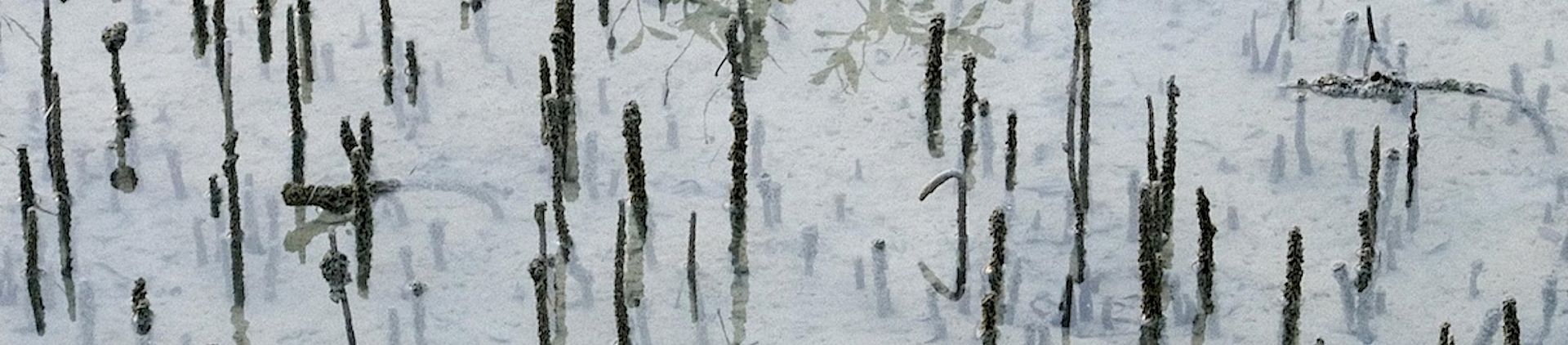
Speaking of the image, Adele says: The photograph has been taken from an ongoing project in its very incipient stages, documenting various mangrove ecosystems in the UAE, which cover more than 150 km2 of land along the country’s coastline. Acting as natural windbreakers, nurseries for many fish species, and important sites of carbon dioxide sequestration besides other functions, they have been a key focus in the country’s conservation, restoration, and sustainable management policies.
On a formal level, I am often drawn to making such images which disrupt one’s sense of space and direction, partially abstracting what the viewer is seeing, to push for an extended time of looking and assessment of the viewer’s own sensory impulses.
This piece is published in tandem with Wasafiri 122: The UAE Issue.
When you left us, I didn’t cry.
All my life, crying has felt like the most authentic reaction to most encounters. A voice raised a decibel too loud, tenderness expressed unexpectedly, anxiety simmering in the pit of my stomach — tears were the most instinctual response. But you leave, and I don’t cry; though I stare with a heavy heart, as Baba does.
When you leave, and my eyes are dry, and it's too early in the morning to fully comprehend what’s unfolding, Baba paces from one room to the next, left hand tightly clenching his cellphone. His heaving breaths and heavy steps are the only sounds reverberating through the apartment, a space suddenly so much smaller and emptier and quieter than I ever remember it being. All my life, I have complained that our place is too small — two shoebox bedrooms, one bathroom, and a conjoined kitchen-dining-living room for a family of four that’s obsessive and particular and private. It was a poor real estate choice on Baba’s part all those years ago.
I don’t know what he’s looking for, but Baba’s looking for something. I’m sitting with my dry eyes at the dining table, body unmoving, following his every step. I can see him inside the bathroom, opening the sink cabinet – pausing for an aching second – then closing it firmly. He spins on his right heel, pulls the shower curtains open, pauses again, then yanks them closed. His pushes and pulls, openings and closings, are tenacious, as if – maybe, somehow, for whatever reason – you would be in either place, limbs folded into narrow compartments. When you are nowhere to be seen, he releases a heave, paces out, and enters the next room, searching in every hidden space he can find.
When he steps out of my bedroom, he looks at me for the first time since I told him that you left us this morning. He’s wearing an old T-shirt from the last family trip he joined us on and shorts that land right below his knees. I have never before looked at my father and thought he appeared small.
‘Did she say anything at all about where she went?’ he asks, panicked.
I look down at the table, trying to find the words. It’s July, yet goosebumps cover my body. My hands are starting to hurt from sitting on top of them all morning, in search of warmth.
‘I don’t know,’ I whisper. ‘Ma3rf, Obuya. But she really did leave.’
Baba inhales — deeply, shakily. He returns to searching every room again.
A few hours ago – a lifetime – I am sitting in the exact same spot at the four-seater dining table, eating Honey Loops out of a bowl I bought one afternoon with Mama some years ago. Mama walks out into the living space, holding her phone up to her ear and murmuring. Her focus is fixed on the front door. She halts when she notices me there, eating, like I am an interruption. Her eyes are wide and her lips are moving to say something, but I can’t hear her.
‘Huh?’ I pull one headphone out of my ear, mouth full of crunchy honey.
‘I said, why are you awake? Don’t you have your driving test at eight?’ She lowers her phone, holding it against her chest. ‘You can’t drive with less than four hours of sleep.’
‘I feel too anxious to sleep,’ I admit. ‘But I’ll go to bed soon, wallah. Don’t worry about me.’
She looks at me for a few long seconds. ‘I can’t help it.’
‘Ummy, it’ll be okay,’ I laugh. 'Worst case scenario, I flunk and retake it. Are you still picking me up after the test?’
I don’t remember if I noticed that Mama was shaking throughout our conversation. Or am I imagining it retrospectively? I don’t know how long we spoke for. All I remember is that, in a moment, the light emanating from all the living room’s fixtures became dimmer and the objects around us disappeared. I remember Mama taking a handful of long steps towards me before squatting down and placing her hands on my thighs, her phone now on the floor. She started to apologise, stammering, eyes rapidly blinking away tears. Her words congealed into each other — her soliloquy of heartbreak indecipherable, as enigmatic as much of her life.
In my memory, she he rises up to cradle my cheeks. She brings her face closer to mine and says something about blame or guilt or forgiveness. But I can’t hear any of it. I only hear that she is about to leave, and I know it’s real this time. Profuse apologies transform quickly into profuse kisses atop my head, on my cheeks, on my nose, on my exposed shoulders. Before she stands up, and I watch her walk into her bedroom for the last time, she looks at my face for what feels like an eternity. Her eyes shift ever so infinitesimally from one inch of me to another, and I know that it will be the last time I will ever see her. The last time she will ever see me.
I breathe in her facial features — big eyes, pointed nose, freckled cheeks, and the thin lips that I did not inherit.
After an eternity too short, she gets up and walks into her bedroom, emerging again in her hijab and abaya with two suitcases. She pulls them hastily towards the open door, not looking back for a second. I sit at the dining table with my soggy cereal and silence, all the bubbling anxiety of a driving test now dissipated. I look at the closed door with my mouth agape, knowing it will never open the same way. Knowing that Mama is gone, and I did nothing to stop her.
When Baba comes home a few hours later, he is too immersed in a work call to notice me at the dining table. He walks into his bedroom, coming out minutes later, car keys in hand replacing his phone. He stops in his tracks when he notices me – almost exactly where Mama had been standing a lifetime ago – and asks, ‘What are you doing home? Aren’t you supposed to be taking your driving test right now?’
I don’t respond; Baba puts his keys down and walks towards me. ‘Maitha, sho el salfa 7abeebty. Shay 9ar? You’re scaring me. Did something happen?’
I am wordless and still, eyes shifting between disintegrating bits of cereal and the floor and his eyes and my hands. When his questions go unanswered, I hear him call out, eyes darting to his bedroom door. ‘Lulu! Can you come to the living room?’
He repeats Mama’s nickname – he had given it to her absentmindedly during my childhood – a little louder. Then he looks back at me. ‘So? What happened? Why aren’t you at your test?’
His words do not conjure Mama to the living room, and I can’t speak. It seems that this renders him wordless too, not used to having his questions unanswered. He looks at me intently for a second, eyebrows slightly furrowed, before turning around and calling ‘Lulu!’ again.
Baba disappears into his bedroom. I am yet again unmoving. How do I tell my father that our life has forever been altered? How do I begin to understand it for myself? You leave and I don’t know why you leave it to me to break Baba’s heart. But you do, and I am still and dry-eyed, and so, so cold.
I hear Baba ask if I know where Mama is from inside one of the rooms. When he comes out again and looks at me – lips pursed, body frozen, shocked into place – he knows. He knows. Just like I knew. Like how you know you’re going to fall in love with someone from the way your eyes meet. Or like how we knew that Khalifa had died, when the phone rang halfway through iftar three summers ago.
How the universe sometimes speaks to you in an invisible language only your chest can hear.
Baba’s first instinct is to call her. His right palm covers his lips as he waits for her to pick up. He keeps trying until it dawns on him that this is it. That she didn’t tell him anything because she never intended to. Mama – like she always knew she would – had left.
For the first time in his life, Baba takes a week off work. He can’t do any more than pray five times a day. I am inconsequential to the world in the summertime and do not have to inform anyone that I won’t be leaving my bed for seven days straight. Baba and I don’t speak to anyone, dissolving into silence while our winding inner monologues do little to contain our confusion.
At some point on Saturday evening, the day after Mama leaves, I hear the soft clinking of utensils from the other side of my bedroom door. The familiar rhythm is enough to remind my body of its consciousness and stir its need for sustenance. My heart feels heavy, but my body guides itself out of my bed and room. I make my way closer to the source of the sound and notice two bowls of white rice set on the kitchen island. Baba stands in front of the fridge with his back turned to me, rummaging through its compartments. My abandoned bowl of Honey Loops stares at me from the distant dining table — I avoid eye contact.
When Baba turns around, he’s carrying a tub of roub and a tablespoon. His eyes shift to look at me, but then he looks away after a beat, dolloping a spoonful into each bowl. When Baba puts everything back into place, he does it all wrong; the roub is on the wrong shelf of the fridge, the pyrex of leftover rice isn’t correctly sealed, and he leaves the tablespoon stained in the sink. But I am as wordless as ever as he passes me the bowl with the larger portion. He takes his own and treks back to his bedroom, shutting the door behind him quietly.
3aish o roub is a sanctimonious dish, one of the most versatile food combinations I have ever seen. Growing up, Mama would make us 3aish o roub whenever our stomachs swelled with discomfort or when our bodies ran a fever. It was an inherited recipe for the body and soul, the quickest remedy for any ailment one could think of. When I bring it back to my bedroom to eat, I wonder if it can ease loss, too.
On what I think is the fifth day, I’m laying across my twin bed, nestled into a corner of the bedroom. My comforter is abandoned where it fell on the floor yesterday, and my body is bare and still, facing the blank beige wall. It feels foreign to spend so much time within these enclosed walls. After Khalifa died, I stopped sleeping in the room altogether, instead contorting my body on the tight living room couch every night. But the living room is too overwhelming, and I am too tired to move. I squeeze myself further into the foetal position, vigilantly avoiding looking at Khalifa’s bed in the opposite corner.
Had it not been for the sound of three gentle knocks on my bedroom door, nothing would have pulled me back to reality and the day would have lulled into oblivion. I blink a few times, my muscles feeling tense as I push my body upwards, shifting it to face the door. The door handle moves downwards and pushes open, revealing a few inches of my father’s body.
‘Can I come in?’
I nod wordlessly, pulling my thighs toward my chest. He walks in and shuts the door by stepping back against it, and does not resolve to move for the rest of our conversation. For a few pregnant moments, Baba and I don’t say anything to one another, and I don’t question his silence. I don’t question why he came in only to stay by the door. Everything is within the realm of reason now — nothing could feel delirious after Mama’s departure. Baba could tell me he was quitting his job and retiring to a life in bed, full of grief, and I wouldn’t reprimand him. But he simply stays silent, eyes averted towards the ground.
‘I’m going to call your aunt,’ he finally breaks the silence. ‘I’m going to ask her if she knows anything.’
I nod. Of course, I had been thinking about calling Khalo Mariam the day Mama left. But, for whatever reason, I had made an internal steadfast commitment to my wordlessness. Perhaps it wasn’t my loss for words that rendered me unable to pick up my cellphone and call someone, anyone, asking for clarity or help. I did not want to confront what had happened. As long as I was in bed, eating bits of leftovers every day, maybe it would render the circumstances of our past few days ephemeral. From how Baba asks me if I can stay by his side as he calls Khalo Mariam, I know that my means for coping are shared.
As he places the call, Baba’s breathing stills. She answers on the second ring. After several days defined by silence, by getting no answer, hearing the voice of Mama’s younger sister leaves Baba stunned. He takes a second to breathe before putting his phone on speaker, stepping forward to place the physical device on my bed and away from him, as if it would soften whatever blow is bound to strike us. Khalo Mariam’s voice is tired and strained.
'Are you doing … okay?’ Khalo Mariam says after she and Baba greet one another. I stay silent.
‘I don’t know how to answer that,’ Baba breathes out. ‘How could I be?’
‘I know this is hard,’ she says carefully after a few seconds. ‘But she first brought this up years ago. You knew she'd been wanting to leave for so long.’
‘But not like this, Mariam, not like this,’ Baba shakes his head. ‘You don’t just get up and leave your family at 4am on a Friday. Not without a warning. Not without a plan. Not without a goodbye.’
‘I don’t know what the right thing to say is,' she says quietly. ‘I don’t know what the right thing for her to have done is. But she’s done it.’
I watch as Baba moves slowly to sit at the foot of my bed. His movements are calculated, eyes fixed to the ground, and I know he, too, can’t bear to look at the opposite corner of the room.
‘Where is she?’ Baba finally asks. The question spills from his tongue, the week’s first interrogation towards honesty. Somewhere deep inside – I realise as I remember this – Baba and I didn’t really want to know where Mama was. Knowing her whereabouts is knowing where Mama would rather be other than by our side.
‘She told me not to say,’ Khalo Mariam responds finally, and I’m ashamed by the relief washing over me. I loosen my grip on my thighs. ‘But you’ll know soon. I’ll tell you soon. Just … not now. You have to wait a little.’ I grip a little tighter again.
The end of the phone call marks the last confrontation with honesty Baba and I have in the first week. When our paths cross at home – tired bodies placing empty bowls of food in the over-exhausted sink – our silence remains undisturbed.
On the eighth day, my rumbling stomach cues my routine short walk to the kitchen. I step into its vicinity and mindlessly move towards the cupboard above the sink to get myself a bowl, only to stop dead in my tracks. The sink is empty, bowls tucked away and hidden. Instead, all I encounter is a hazy reflection, of a face inherited paternally — no mother in sight.
Doing things for the first time since Mama’s departure feels a little like stretching out your entire body. You have to breathe gently and lean in further, despite the tension in your muscles, despite how much you want to let go.
Our stretch begins on the day both Baba and I realise that our fridge is empty. Anxiously, I volunteer to walk to the hypermarket just a few buildings down from our apartment. Baba is silent. He disappears into his room, coming back a few moments later with his car keys. Our uncoordinated pirouette towards restoring normalcy is so vivid in my memory. I remember it beginning that very day, when Baba and I went to the nearby Lulu’s. We were awestruck by the sheer amount of things we needed to buy to get us through another week. Neither of us dared to mention the irony.
I remember the process accelerating. A few days later, we’re both seated on the living room floor, sifting through the hill of laundry we’ve washed for the first time. It is past midnight. Our hands intricately fold the textiles and fabrics that will hang from our bodies for the next dozen days, until the hill will need to be washed all over again. It accelerates when we finally clean the house, a day’s worth of mopping and vacuuming and dusting every edge and contour until we are too tired to move our bones. Somewhere in the midst of it – perhaps between the ebb and flow and whir of Baba requesting shorter workdays and my idling around the house with nowhere to go and nobody to see – our pirouette stops being so shaky. At some point, I begin to hear a rhythm slowly building between us, in place of silence.
The driving centre only lets you schedule one test a month, so it’s August when I wake up early enough to get ready for the test I had missed the morning you left. When I sit down before my bowl of Honey Loops this time, I eat it clean before heading out the door.
I always think of your decision to leave the way you did, in the silence and dark of the dawn, with the intention of not being seen. In hindsight, I realise that even in your search for yourself, you are still hiding. I wish I had told you that you did not have to.
In an alternate universe, I know all that I know now. I am seated with you in your bedroom on the night you leave. I help you fold your clothes with precision and pack your suitcase for you. I spray five spritzes of your favourite sandalwood perfume on your skin – one spritz on each collarbone, one spritz on each wrist, and one spritz on your chest – and carefully apply oud on each side of your neck. I kiss you on every place your soft kisses grazed my skin the day you left. I gently brush your hair, tie it back into a low ponytail, and wrap your hijab carefully around your head. Baba walks into the room with a warm cup of tea to fuel you for the rest of the evening; we hold your hands as we head toward the door.
I sit in the driver’s seat and take you to where you are now. And when you leave again in that universe, our hearts will break once more, but we won’t come back for you. We will not search for you. We will not ask questions. We will drive back home in silence, just the two of us, and learn how to live in a world empty of you, all over again.
Image: Jubail, Abu Dhabi © Adele Bea Cipste


Our summer special issue, guest co-edited by Laure Assaf and Deepak Unnikrishnan, explores the United Arab Emirates’ literary and creative scene — away from monolithic representations of the region. Its contributors are makers – of books, arts, texts, and community – with ties to the United Arab Emirates and/or the Gulf. They are brought into conversation across generations and disciplines, reflecting on what this place is for them, and what it does to them. They talk about risk, memory-making, taxis, and televised dreams — pushing the lines, or treading them carefully.