New, Old, and Imagined Homes by Nadeen Dakkak
Extracted from the lead feature in Wasafiri 122: The UAE Issue, this personal essay by Nadeen Dakkak charts her familiy's movements across the Gulf and beyond, reflecting on the ambiguity, silences, longing, nostalgia, and practicalities of serially migrating.
You can download this full piece for free from the Taylor & Francis website, or read Wasafiri 122: The UAE Issue in print, available to order now.
My first visit to Dubai in December 2021 brought me face to face with my unhealthy obsession with the permanent marks that living in Kuwait as a third-generation Syrian has left on my being. It was not the first time that I found myself feeling hyper-conscious of the difficulty of disentangling myself from this place — and all the ways it shaped my character and thinking. A question I often ask myself, as someone who studies the Gulf, is how much my entire critical perspective, and my reading of Gulf migration stories, inflicted my background as a child of the Gulf, and by my very particular experience of having grown up in Kuwait. It’s an uncomfortable question, but I feel compelled to return to it every time I am confronted with the seeming narrowness of my perspective — and with the way in which my conflicted relationship with Kuwait relentlessly haunts my life, even years after I have adopted the UK as another temporary home. Although I was in Dubai to visit family, and not in my capacity as someone who reads and thinks about the Gulf, I felt compelled to ask these questions. Spending time with relatives who had to leave Damascus, and who, for the past decade or so, had made Dubai their new home, was perhaps the reminder I needed that not only are there other Gulf places that are not Kuwait, but there are also other ways of being in them – other feelings, other stories, and other possibly conflicted relationships with the places we inhabit semi-permanently – even if I may struggle at times to place them alongside my own.
My aunt and her family relocated to Dubai during the second half of 2012, after the situation in Damascus had become increasingly worse. In subsequent years, they were joined by others from the extended family, including my cousins, my uncle, and his wife. Both my aunt, and my uncle, the eldest of six siblings, had spent their childhoods in Kuwait in the 1960s and 1970s before settling down in Damascus following their university education. Their families and houses constituted the small yet charming Damascus I knew, and whose features shaped all my childhood summers up until 2011. It was during those warm Junes, Julys, and Augusts that I got a taste of what it is like to be part of a large extended family that gathers every Friday over food at the matriarch’s house. Those summers were the best part of my childhood. Their richness compensated for the banality of my life in Kuwait, and my hazy dream-like memory of them might be the reason why I still feel incapable of comprehending the fact that the Syria I had known no longer exists. My siblings and I roamed the old city’s streets and bought souvenirs like tourists, always shy and failing to haggle over prices with the hope of dispelling immediate recognition of our identity as mughtaribeen, emigrants, estranged Syrians. Every June, we emerged out of the sheltered, air-conditioned cocoon that is life in Kuwait, and indulged in freedoms that were grand in their mundanity — solitary trips to the ice-cream shop nearby, card games with cousins late into the night, or a makeshift all-kids evening picnic in the garden of my grandmother’s residential block. Like other migrant kids lucky to escape Kuwait after the end of the school year, those summer months were our chance to connect with the home country. They brought us, the branch of the family that remains in Kuwait, together with the branch of the family that settled in the United States in the 1980s, together with the branch of the family that re-established itself in Damascus after those early decades in Kuwait. I still remember those encounters with cousins as a jumble of accents – a mix of Arabic and English – just as I remember being introduced to new Syrian words and trendy slang that did not exist in my family’s diasporic lexicon.
The tragic war in Syria led to an abrupt and painful departure from cherished homes and neighbourhoods. The war also brought these dream-like summers to an end and banished my grandmother’s, aunt’s, and uncle’s houses to the edges of my memory. I had only ever had a fleeting presence in these spaces, and have not returned for a visit since 2011; nor have I really been capable of adequately understanding how the war completely transformed the lives of my relatives — those who left and those who remained. There is a kind of vagueness that engulfs my memory of those early years that saw my aunt and her family gradually leave Damascus and settle in Dubai. I do not know if this vagueness was caused by my own detachment and introversion during a time of insecurity for my family, when I constantly feared the prospect of being forced to leave Kuwait for a war-torn country, or whether it is more a result of how painful experiences are sometimes collectively dismissed from the conversations and registers of an extended family once better times have arrived. I do not know whether it is possible to fill those gaps in my memory, or to find an audible way of articulating those silences that have long pervaded my family’s history of dislocation — even before Syria’s present tragedy. I can imagine, though, the unsettling experience of dislocation that my aunt and cousins navigated, just as I can feel in my bones the challenges of building a new life that feels both temporary and open-ended. I see pain, confusion, and uncertainty in the most practical of decisions, from the size of the flat they needed to rent, to whether it was worth buying certain kitchen utensils. I was raised by a father for whom some things were too much of a luxury to buy in a country that may eject you at any minute, even if you somehow ended up spending the remainder of your life there. I know by heart the rituals and struggles of infusing meaning into an everyday existence that is underpinned by fragile connections with place. Notwithstanding these struggles, Dubai soon became a meaningful place for the extended family, not just for my aunt and cousins. It became a new node in my family’s diasporic history, a place where those Damascus summer gatherings could be recreated, albeit in cooler winter months. My aunt’s big house came to replace my grandmother’s, hosting siblings, nieces, and nephews visiting from Kuwait and the United States, as well as new sites of dislocation — France, Slovakia, Canada, and Egypt. Instead of passionately quarrelling over the allowed play spaces and hours with the overprotective janitor and gardener of my grandmother’s building in Damascus, the kids of the family now got to freely kick and throw balls on the artificial grass of my aunt’s yard. My aunt’s cooking has maintained its superbness and some of the best foods of Damascus can now be found even more easily in the many new Syrian shops and restaurants that have popped up in the United Arab Emirates (UAE) over the last decade or so as a larger Syrian diaspora has taken shape in the country. In a way, everything and nothing has changed.
Read the full piece here, free to access and download.
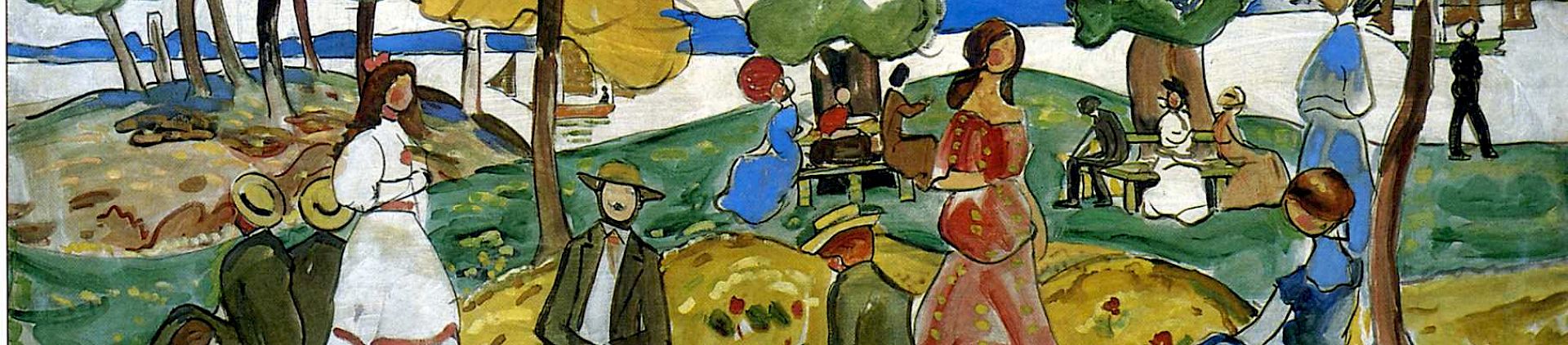
Image: Picnic by Maurice Prendergast


Our summer special issue, guest co-edited by Laure Assaf and Deepak Unnikrishnan, explores the United Arab Emirates’ literary and creative scene — away from monolithic representations of the region. Its contributors are makers – of books, arts, texts, and community – with ties to the United Arab Emirates and/or the Gulf. They are brought into conversation across generations and disciplines, reflecting on what this place is for them, and what it does to them. They talk about risk, memory-making, taxis, and televised dreams — pushing the lines, or treading them carefully.