The River by Kate Hawkes
Kate Hawkes – shortlisted for the 2024 Queen Mary Wasafiri New Writing Prize in Fiction – explores the grief and 'river' of memory within a relationship transformed by illness.
The 2025 Queen Mary Wasafiri New Writing Prize is open until 30 June 2025. Read the full guidelines and submit your work.
Michael looks up at the bus driver as he tips his coins — exact change, warm from his palm — into the fare bucket. He feels his hand trembling, but the driver doesn’t comment. He must not see the cool, brown water that trickles through Michael’s fingers, just underneath his fragile skin.
Before Michael can lower himself onto a seat, the bus swings around the steep corner by the cathedral. Outside the concert hall, a ribbon of chattering people lean against the wall as they wait for tickets. He and Mag had tickets to see a jazz singer there one night many years ago, but James had the flu and Mag hadn’t wanted to leave him with a sitter. She had told Michael to go anyway, but he didn’t want other men’s jackets to be pressed against his arms as they vied to order drinks. He didn’t want to collide with a stranger’s elbow on the armrest of his seat as they turned to whisper to a friend, or to be surrounded by the sickly smell of other women’s hairspray.
Mag would have steered them to a space in the crowd and smelled like lavender soap. She would have had a white wine, and then another, and by the time they were walking back across the uneven streets, her face would have been a little flushed and she would have grasped his elbow as she turned to him, laughing. She slaps at his arm, telling him off for making her laugh so much. He tries to catch her eye, but he can’t quite focus.
But, of course, that is the river getting the better of him. It surges up and clouds Michael’s vision for a moment, murky and speckled with weeds. James had the flu, he reminds himself. They hadn’t gone after all.
Mag hadn’t rested her head on his shoulder in the humid dark of the performance. She hadn’t hummed her favourite songs from the show as they waited to cross the road.
The water recedes down into his legs and laps around the soles of his shoes. It is at bay — for now.
The bus stops outside the hospital. As Michael walks towards the entrance, the tarmac heaves and he has to grasp at a column to prevent an unexpected swell from sweeping him under. But he spots the sign for Mag’s ward. He focuses on the plastic strip that bisects the walls and follows it until he arrives at the swing doors.
As Michael moves towards Mag’s bed, a nurse calls to him. He gives them a nod and a slight wave that could mean anything, but he does not stop. He must keep moving or the river will rise again. It is gurgling between his ankles and lapping at his calves.
But then it’s just him standing at Mag’s bed. Someone has parted her hair in the middle rather than over to the side, and her pink nightie, sodden with river water, sags to reveal a collarbone and the tip of a shoulder. A curl of seaweed clings to her cheek. Michael gently lifts the nightie back into place as he leans in to kiss her cheek.
‘Hello, love,’ he says. ‘How are you today?’
Mag’s eyes turn to him. Her fingers up above the waterline and close around his knuckles. ‘How are you?‘ he asks again.
Mag leans in and rests her head against his cheek.
‘Are you well?’ she asks into the dip under his jawbone. He feels the cool, shallow breaths, and smells the metallic-edged earthiness of the water. Michael pulls black slightly so he can look at her again. Today, the river is rushing around her ribcage. He can see from her gulping breaths that the current is pummeling at her lungs.
Michael notices a small bruise leaching violet into the skin on the edge of Mag’s hairline. It is vivid and accusatory.
‘Is that new?’ He motions to the bruise and Mag’s hand drifts up towards it.
‘What is it?’
‘The bruise on your head.’
‘Do I?’ Mag’s fingers rest on her forehead but her gaze slides behind him. ‘They’re poisoning me,’ she says quietly.
They sit in the stripes of sunshine that burst between the blinds. Someone has opened the window and the sounds of the summer drift across the bed too, tangled up in the hot light.
The street outside is loud with young people. The seagulls join in, competing for ice cream cones and crumpled paper.
Once, Michael remembers, a gull had swooped so close that he had felt the swipe of feathers on his arm, surprisingly sharp. That same afternoon, they walked into the edge of the waves on Killiney Beach, and then sat and counted the boats that hovered around the horizon. His socks were still damp as they traced their way back along the railway tracks. There had been biscuits, and his feet had been sore.
Michael doesn’t dare hold the memory too tightly. He knows it will trickle through his fingers.
They sit, hand on hand, watching something on TV. A nurse in a rustling disposable apron presents them with tea — Michael’s in a paper cup, Mag’s in a two-handled plastic sippy mug like the ones they gave James as a toddler. Mag makes a cartoon grimace at Michael as they hand it over, and he winks at her.
Michael looks over her eyebrows, her eyelashes, nostrils, cheekbones, and ears, making himself notice everything that is the same. All the while, Mag bats at twigs and leaves that have become swept up in the river’s flow and are pushed towards her in a tumbling rush. She always has to be doing something with her hands — tapping, straightening, adjusting. The first time they met she had leaned over and straightened his tie without thinking.
Michael waits until the dinner lady comes around with sandwiches before he rises to leave.
Mag’s hand grips his tighter. She pulls him in to her, her wrist straining and quivering. He places his arm across her shoulder but daren’t hug her delicate frame like he used to. Michael smells the wrong shampoo and the wrong soap and all the scents that aren’t hers. He tries to blink away the flecks of weed that swirl up and obscure Mag’s face.
But he touches the back of her soft hair and kisses somewhere in the warm fold of her neck.
‘Look after yourself,’ Mag says. And for a moment, he can see her clearly. He sees her turn towards him at the top of the road, her hair drying into salty curls in the warm wind, one hazelnut swirl trapped across her left ear by her glasses. They had stumbled, screeching, into the edge of the waves, the freezing stones digging into the balls of their feet.
In front of the unbelievable blue of the bay, he sees Mag rummage in her handbag and pull out the packet of digestive biscuits she always made space for. He sees the coral beads he bought her in Corfu rolling lazily across the top of her chest as she walks, and the blush of her smiling cheeks. He sees her sitting up in her hospital bed, smoothing the bedcovers and waiting for him to promise he’ll take care of himself.
Michael looks up at the bus driver as he tips his coins — exact change, warm from his palm — into the fare bucket. At the top of the hill, the bus draws away from Michael’s stop and reveals the relentless spread of the city. Yellow light spills from the river, trickling up through side streets and between buildings, onto the shutters of the closed cafes and corner shops.
Vehicles race towards him and skirt the cathedral grounds. Even the traffic lights can barely hold them at bay: cars push and snarl against their orders and gush past a split-second before the lights give way. Their small worlds flash past and are gone.
Michael watches until the repetition of the traffic lights makes him dizzy and the soles of his feet ache. The buses and bikes, cars and vans, lorries and motorbikes rush, still.
The river inside Michael surges too. This time, he lets it swell through his limbs and fill his fingers to bursting.
He feels it sweep up his organs, hammering at his chest and buoying up his heart. It roars past his eardrums and into rivulets around the roots of his hair.
Today, he can see down through the cathedral, all the way to the low grey wall that hems in the Liffey’s edge. He sees the broad dome of the sky and the brown sheen of the water that sweeps past chattering tourists and furious seagulls, towards the port and where it rushes out into the huge basin of the bay. The irresistible flow pulls the sun down to its surface and threads of light glint across it like Mag’s eyes when she has done something she shouldn’t.
For a few moments, Michael is in the stillness above it all. He looks up and exhales globules of river water into the early evening sky.
The 2025 Queen Mary Wasafiri New Writing Prize is open for submissions until 30 June. Submit here.
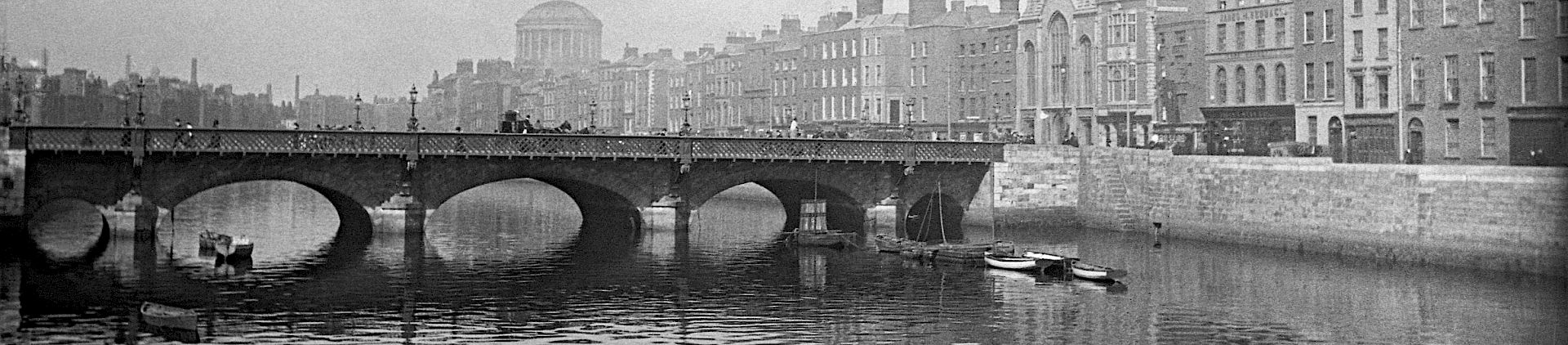
Image: L'Estrange, Robert Augustus Henry (ca. 1898) Grattan bridge on the River Liffey and the Ormond Quay Presbyterian Church Dublin Ireland circa 1898. Courtesy of Queensland University of Technology.
