Bodies of Knowledge: A Multidisciplinary Event
As more of us grow disillusioned with how knowledge is produced within the bounds of institutions, we increasingly turn to alternative spaces and methods. The body itself is seen as a vital site and generator of knowledge, where its movements and immediate viscerality can counter the neutralising, dehumanising, and alienating ways in which academia, media, and other elite institutions treat people’s lives in their pursuits of a thesis or argument.
From digital platforms to independent publications, activism and organising, performance, sociology, interdisciplinary production, and more, many practitioners are (em)bodying knowledge in fascinating new, hybrid ways, especially given the exponential explosion of online worlds. This July, join us for a multidisciplinary event in London, featuring a performance lecture by Jason Allen-Paisant and a roundtable conversation with Hazem Jamjoum, SJ Kim, Chantelle Lewis, Louisa Munch, and Nat Raha – chaired by Wasafiri Associate Editor Maya Caspari – to gather and explore these varying perspectives on who creates knowledge and from where.
Drawing on Donna Haraway's reminder that ‘the body does not end at the skin’, this event aims to understand knowledge not as a neutral collection of data but as a set of borders that determine where meaning is permitted to be made. Together, we want to ask something practical: how do we locate, share, and build knowledge when the institutions that produce and store it remain skewedly insufficient in who they serve?
When: Friday, 10 July, 5–8pm BST
Where: BLOC Cinema, Queen Mary University of London
Tickets: £20 for both the roundtable and keynote. £10 for keynote only. (Concessions available)
Full Programme
Roundtable: Who Gets to Make Knowledge?
5–6.30pm
This roundtable – structured as an open conversation rather than a traditional panel – will feature Hazem Jamjoum (Safarjal Press; British Library), SJ Kim (University of Warwick), Chantelle Lewis (Pembroke College, Oxford; Surviving Society podcast), Louisa Munch (University of Warwick; @louisamunchtheory), and Nat Raha (Glasgow School of Art). It will be chaired by Wasafiri Associate Editor, Maya Caspari.
Keynote Performance: SNOW – Jason Allen-Paisant
7–8pm
At the centre of this work is snow itself: not simply as landscape or climate, but as psychic condition, historical force, and metaphysical atmosphere. SNOW is a counter-cosmology built around the Mesoamerican plumed serpent Quetzalcoatl: an attempt at understanding recurrence, catastrophe, sacrifice, struggle, and time itself, in the current world shaken by crisis. In the work, Quetzalcoatl becomes the poet's lover, and an erotic-mythic system running beneath the book's political weather.
This performance is excerpted from Jason-Allen Paisant's forthcoming book-length poem of the same name.
Jason Allen-Paisant is a poet and writer interested in intimacy, memory, and what happens when history presses directly on the body. His work moves between poetry, prose, and philosophy, often asking how we keep living, sensing, and loving in the aftermath of colonial and ecological rupture. His books include the award-winning poetry collection Self-Portrait as Othello, and the philosophical treatise Engagements with Aimé Césaire. He is Professor of Critical Theory and Creative Writing at the University of Manchester and is currently a Fellow at Columbia University’s Institute for Ideas and Imagination in Paris.
Maya Caspari is a writer and researcher. She is a Lecturer at the University of York. Her work explores the ethics and politics of research and writing in the contemporary moment, focusing on how contemporary writers experiment with ‘touch’ as a method for remembering violent histories and reimagining relationality. Her poetry book Almost, with Tenderness was published with Out-Spoken in 2025. Her forthcoming monograph is called Reading Frictions: Memory, Violence, and the Politics of Touch in Contemporary World Literature.
Hazem Jamjoum is an educator and lead editor at Safarjal Press. He is also a curator of the British Library’s early twentieth-century audio recordings of relevance to Arab and Gulf History. His work aims at digitising, cataloguing, and contextualising this part of Arab communities’ audio heritage. He has also co-led a project aimed at identifying similar at-risk audiovisual collections in the region with the longer-term aim of fostering such preservation and curatorial work on a wider scale. His doctoral research in history at NYU traces the connections between the production of 'Arabic music' as a concept and a commodity, and the implications of these production processes on supra-state collective identifications, pan-Arabism in particular. He recently translated Ghassan Kanafani’s The Revolution of 1936–1939 in Palestine and Maya Abu Al-Hayyat’s No One Knows Their Blood Type.
SJ Kim was born in Korea and raised in the American South. She is the author of This Part Is Silent, longlisted for the Andrew Carnegie Medal for Excellence in Nonfiction and the Gordon Burn Prize. Her writing on racial, gendered, institutional, and political violence has appeared in Wasafiri, Oxford American, and The Hanok Review, among other publications. She resides in the UK and teaches creative writing at the University of Warwick.
Dr Chantelle Jessica Lewis is a sociologist and consultant specialising in family studies, race, class, and neurodiversity, and the co‑author of We See Things They’ll Never See: Love, Hope, and Neurodiversity (Princeton University Press). She is a Research Fellow at Pembroke College, University of Oxford, and executive producer of Surviving Society Productions, a Radio Academy award‑nominated public sociology platform that has hosted hundreds of conversations with scholars, organisers, and artists worldwide. As CEO of the longstanding live events series The Baby & Toddler Shows UK, Chantelle leads one of the UK’s key platforms for new and expectant parents and is currently developing The Parenting & Wellbeing Show, a new programme of events offering holistic and intentional support for parents and guardians raising families in contemporary society.
Dr Louisa Toxværd Munch is a critical theorist, writer, and educator whose work examines nostalgia, historical consciousness, and the political conditions that have enabled the resurgence of authoritarian and far-right movements. She completed her PhD at the University of Warwick, where she teaches in the English Department. Louisa’s work bridges academia and public engagement, bringing critical theory to a broad audience through lectures, media appearances, and social media. She is the author of the forthcoming book Glitch: How to Think in a Time of Monsters (Allen Lane/Penguin).
Dr Nat Raha is a poet and activist-scholar. Her books of poetry include apparitions (nines) (Nightboat Books, 2024), of sirens, body & faultlines (Boiler House Press, 2018), and countersonnets (Contraband Books, 2013). With Mijke van der Drift, Nat is co-author of Trans Femme Futures: Abolitionist Ethics for Transfeminist Worlds (Pluto Press, 2024, finalist for the Lambda Literary Awards 2025). She teaches in Fine Art Critical Studies at the Glasgow School of Art.
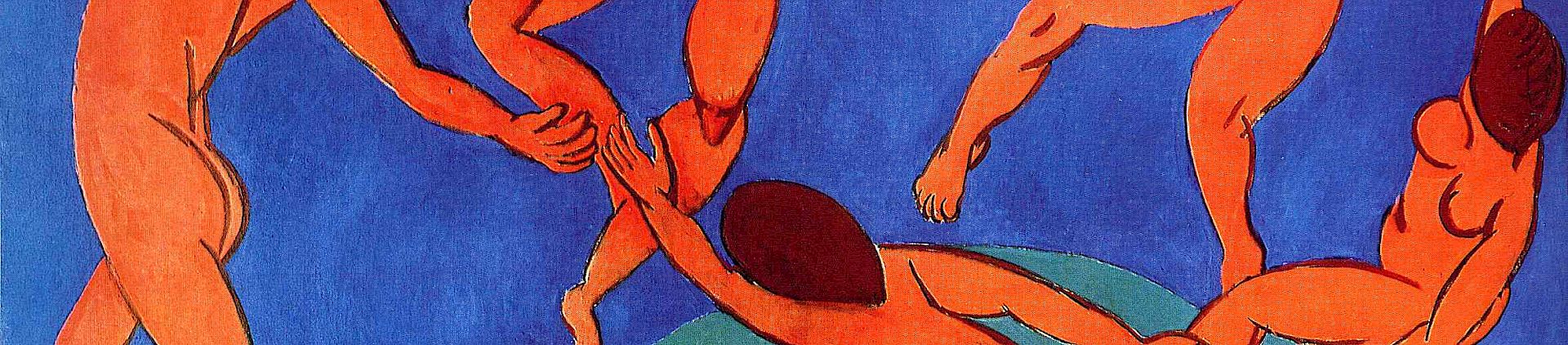
Cover image: Dance (II) by Henri Matisse