Two Poems by Yessica Klein
Yessica Klein's poems, 'I'd Like You To Meet The Brazilian Sun' and '1989' explore different aspects of Brazilianness with humour, nostalgia, pain, and frustration at once — where the 'Sun always has a joint' but fair governance can feel unreachable.
Supported by a grant from the Open Society Foundations.
I’d Like You To Meet The Brazilian Sun
The Brazilian Sun enters the sky
with a Bluetooth speaker blasting Anitta.
He lifts his 90s mirrored sunglasses to his
forehead & waves his left rays in a shaka sign.
‘Suave,’ he says. Smooth.
The Brazilian Sun wears a moth-nibbled
Sepultura T-shirt with deodorant stains,
the malandro smile solid even on
those Julys below 20ºC that give
fondue dates & hand-knitted scarves.
Stand under a sunny corner, he’ll come up straight,
offering you a hit of his joint.
The Brazilian Sun always has a joint.
(He doesn’t mind this cliché.)
His laughter, a contagious smoker’s
cackle, buzzing.
Watch now how high he goes, a straight angle
above your flat cap,
toasting the top of your shoulders
with pink freckles, your shadow
a solitary circle beneath
your flip-flops.
He only takes off in the December afternoons
for the scheduled summer storms,
his comeback saturating the wet hues
back to their tropicalism.
Let his love bathe you in unconditional light.
Let his loud good morning wake you up with a shudder.
Like most poem suns,
he does the talking. Unlike the others,
he never reads your work.
1989
The police officer decided my Mum’s passport
was prettier as purple-pink ribbons. Deportation,
he said, keeping her pregnant self from voting
in Brazil’s first democratic elections since 1964.
Collor wins. Within a year, he confiscates
the population’s savings accounts, part of his planned liquidity block,
but my Mum is not to blame. How about
some information, please? Let’s list all the reasons
‘Like a Prayer’ was her favourite song
in the year of my birth.
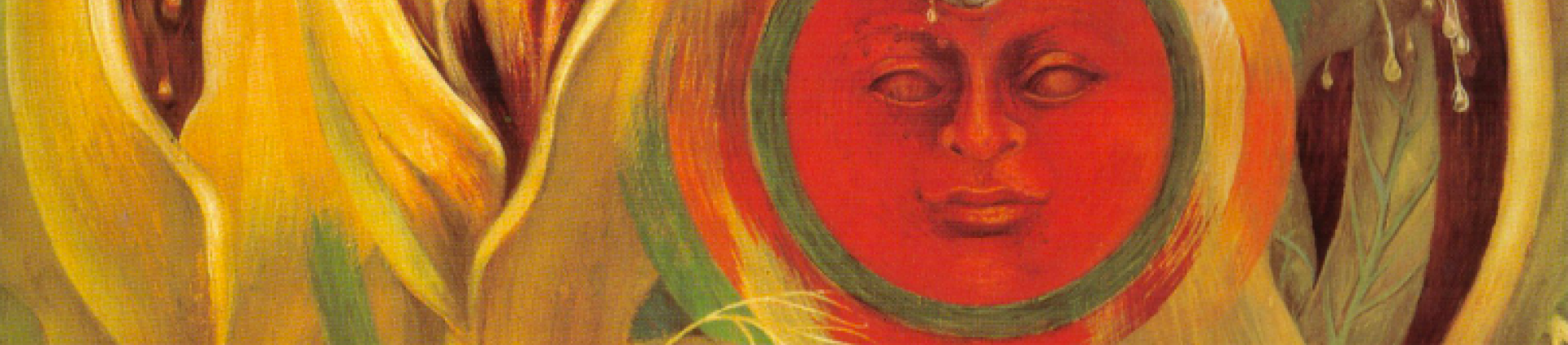
Cover image: Sun and Life by Frida Kahlo


Our winter special issue, guest co-edited by Leo Boix and Karina Lickorish Quinn, critically explores the vibrancy and creativity of the British Latin American and Latinx communities which have been unjustly marginalised — both within Britain and beyond.
