To Get Just a Glimpse of You, I Have Been Everywhere by Kareena Gianani
Moving between cities, memories, basements, and screens, Kareena Gianani's life writing piece explores what long-distance love can look like in a globalised world — where migration becomes a constant, smartphones shape relationships, and rooms gather meaning the more that they change. Through her own personal narrative, Kareena imagines alternative templates for the ways in which women are allowed to move, work, love, marry, and be.
The Man in Toddy
Surrounded by woodlands at my Norwich university, the basement where I write doctoral essays is a quasi-basement, really, sunken into the ground by a foot or two, but otherwise holding on. There and not-there, a glass-half-full kind of place.
At twilight, this room begins to cast reflections on a lone window-wall. I see the outline of my body floating between a cherry tree and an ancient oak awaiting leaves. The weeds outside grow in my chest too; a chamomile blooms in my throat. A cyclist drifts by in the distance, and I eat her up. Then, night falls and the window becomes a mirror. When the woman in the glass room looks up, she finds in the paned window not one but three moons in the ceiling-sky, each refracted crescent a ghost of the other.
It is in the strangeness of this hour that I video call my partner, G. Perhaps I don’t want to disappear completely. I pull into this basement another room from another country five-and-a-half hours ahead of England. G is in India, in the small town of Mananthavady in Kerala, teaching students to build an autonomous archive of the region. It is midnight in his rented room — the math comes to me like a reflex, entirely surpassing my conscious brain. G will be at his desk with a quiet mug of tea, a lime floating in it forever. Perhaps another tower of books is rising in a corner behind him, more discursive translated novels about men whose moustaches terrify the powerful and goats that eat up writers’ manuscripts. His landlord recently borrowed some and found them very gloomy.
My call continues to reach out. Tonight, G would have dined on the same curried chickpeas or green peas packed in a plastic bag, ballooned and tied with a string by Haseena at the tea stall. Haseena (whom I have not met) knows it is easy to guilt G into buying dinner from her every night. All she has to do is remark how she spotted him lunching at her archrival across the street, Pig’s Mess, where cooks Baby and Ginny keep aside their crispiest sardines for the man clearly not from around here. His Malayalam has been elsewhere; there’s surely some Kottayam in it, maybe the faintest echoes of seaside Kochi, but his other lilts are unplaceable.
My video call to G may or may not connect, depending on the Wi-Fi in the vast plantain fields his lodge is in. I may or may not be disappointed. I may show it or may not.
‘You can tell people that I’m a Man in Toddy. Mananthavady = Manantoddy for the Brits,’ G had joked with me over WhatsApp shortly before he moved there, adding a 🌱 and a ❤️ at the end. He was in the UK for his PhD at the time, set to leave just as I was arriving to begin my doctoral research in August 2024. But first, he was planning a brief trip home to Singapore. We were bickering with our screens — he wanted to fly with some dodgy airline to save money. For G, the image of a sapling – tentative leaves emerging from a patch of soil – means he wants to be around, but lightly, hesitantly, because an argument stings. And his brooding, maroon heart is a more solemn version of the regular, bright-red heart emoticon which seems more open to let the world in.
We didn’t always speak in coded algorithms. When we first met, we tried to reach for something essential inside each other by swapping obsessions, as all lovers do. Apart from English, our languages were foreign to each other, and the pleasure lay in translating our worlds, no matter how incompletely. I once showed G a video of Abida Parveen singing a Sufi ghazal in Brij Bhasha, on the sweet surrender of the self in love, translating her verse by verse, making some things up because how would he know anyway? He was more sincere, showing me sonnets written in Singlish, where lovers in Singapore flirted over a dinner of chilli crab, slowly removing the hard outer shells with their hands to reveal soft, tender insides.
My video call to G does not connect; the app blurs and freezes my face onscreen.
Olive Pickles from Dhaka
Above the quasi-basement is my university accommodation, on the top floor of a staircase that spirals like a snail’s shell. Four hundred of us live in this building — some PhDs like me, some Masters, but mostly undergraduates who stride to classes in the morning in their solemn combat boots, only to emerge in fleece-robed cocoons at midnight when a fire alarm rings, their bare ankles soft and exposed.
I share a tiny, two-bedroom unit with my Bangladeshi flatmate, Jonaki. She is my foil, and rather good at Doing What Needs To Be Done. She tops her classes, has landed a rare placement at a consulting firm, and I can reliably tell that another fortnight of my life has passed when she wheels her suitcase to the launderette, softener in hand. I, on the other hand, go underground to a basement that glues all my days and months together. Writing and erasing and rewriting opening paragraphs for my book, seldom knowing where to take these rushes of images, loving their disjunctions just the same. I thought they’d be a proper, tellable life story of a journalist who took a mad risk in her late twenties, now, years later, wondering where it has taken her.
‘So … how are things with G?’ Jonaki asks me one night in our one-woman-at-a-time, box-sized kitchen. It is meal-prep Sunday, so she has arranged twelve plastic boxes to cool on the counter: one small hill of rice, one splash of vegetables, and one chicken leg in each, gleaming and teasing like those food displays in Japan. I, exhilarated at the recent vanishing of my appetite due to a new medication, simply skip meals or heat Tilda’s microwave rice in her pan. Doing this somehow conjures Jonaki in the kitchen like a wish by my side, her mother’s olive pickle in hand, which she carried to Norwich from Dhaka. To me, her Ziplocked olive pickle reminds me of her decision to never return home and risk some unexpected, overnight visa ban. She stays put.
She often asks me about my cross-border relationship. Jonaki – who endures her nerves to master painful varieties of British small talk at her all-white firm, who can whip up complex Excel sheets to predict our energy consumption patterns – is afraid of love. Terrified, even. She does not date because at twenty-four she says she knows people’s intentions come without guarantees and warranties. And I? I have loved a man over a smartphone for ten years, as we dart like snooker balls between Bombay, Singapore, the American Midwest, Kerala, and the UK for work and funded writing degrees — separately. Now, five years into the marriage, I’m in Norwich to write a book on long-distance love; I like to tell people it’s a story about love and freedom. Jonaki asks how the two can be related.
All the Lovers in Bombay Balconies
Ten years ago, when I first met G, he was the tall guy walking ahead of me in a disused Bombay mill compound renovated as a mall with luxury furniture stores and upscale restaurants. I noticed how we both didn’t belong there – us with our backpacks with rough edges, ignored out of love – but then you could say that about the library we were headed towards as well. Somewhere above a Mercedes service showroom overlooking a cemetery, an independent library-bookshop had sprung up in a building with a defunct elevator. G was a curious passerby in the city for six months; I was a lifetime member. He told me stories about growing up in Kochi before his parents decided to move to Singapore. I told him how Bombay was the only place I knew as well as my body. After work, I took packed, peak-hour trains, sometimes hanging from their open doors, just to meet him. G’s rented little room was on the twentieth floor of a building. Rain became mist before it touched our faces and, suspended that high above ground, we fell in love before giving a thought to how Bombay and Singapore might ever cross paths.
When my reluctant Singaporean boyfriend asked me why I’d risk long-distance with him, I told him to think of the millions of couples hiding, right now, in other balconies of Bombay — whispering into their phones, clandestine-texting from shared rooms in joint families like the one I’d grown up in. I wasn’t from the old money of Cuffe Parade or Bandra and its hipster-cool, multinational professionals. I was used to living a double life at home — working my way up to become a travel editor at the National Geographic to the world, but hiding lovers from my family for a decade. Around me, all love was often a transgression, and freedom was whittled in hiding. In that sense, every relationship here is a long-distance relationship, I said to G, and rested my case.
I like to tell people it’s a story about love and freedom. Jonaki asks how the two can be related
Having sworn off arranged marriage and following that man to some distant city, what millions like me attempted was to magically present ‘the one’ to their families six months before marriage. With no room to date in Bombay other than through games of hide-and-seek, I wondered: how different could things be with a man in another country? What I didn’t know is that loving G would mean watching six-inch smartphone miniatures of him moving through the world. Seeing him on midnight grocery runs at the supermarket in Singapore, amid soup cans and sardines: six inches. The size of his annoyance when he once trudged up the stairs of a London library in sneakers soggy from the rain: six inches. We didn’t know that ‘a few years’ would eventually become a decade. Meeting only twice a year in a different place – from strangers’ AirBnBs to noisy lodges – has etched our shared life into my brain not by year but by the intensity of our stolen time. In a love that moves across borders, a whole city can collapse into an image of a tram ride, the light and shadow it cast on G’s face. A year might vanish from my memory after a relational rupture, only to return and feel like yesterday. There is no home where G and I think about cooking dinner together. We know nothing about the oldest marital spat in human history: who will do the dishes. This love is a roundabout of six-inch boxes — virtual rooms within virtual rooms, where we watch films together on video calls, overthink the duration of texting app ellipses, and feel less loved when WhatsApp halves the size of its red-heart emoji overnight.
Had I known that a relationship will forever alter my perception of time, and make me experience everything, every place, all at once — would I do it differently?
A Mother’s Membership of a Lifetime
On this digital roundabout where the lover’s presence is contingent, it is other women who meet me wherever I am. In my Norwich basement, for instance, I can always bring my mother in from my childhood home and other left-behind rooms. She never left the city of her birth, nor has she ever been to a basement — Bombay’s homes don’t usually have them. But look at how she brims over the box of her phone into my basement, spreading out on our old living room couch without a care. My mother, in her billowy Batik nighties, always starting our video calls with ‘I just wanted to see your face today’ in Sindhi. I’m still getting used to the new glint in her eyes after her cataracts were recently removed and lenses inserted. Like billauri, rhinestones — she teaches me specificity when I try telling her she looks lit up from inside. My mother, who knows I need the right words.
She comes to me at the right time, telling me how to look, and what to look for. There’s a time to search for a person’s pores, and there’s a time to take in the long view — what’s more useful right now? But sometimes my mother misleads me too, unintentionally. Or her phone does. Her camera reflects not one new wrinkle on her face – perhaps she will live forever – which tricks me into thinking that home, too, is the same. But every time I go back to our flat in the squat, old, three-storey building among high-rises, I see new wooden limbs growing from our walls. A cabinet in the kitchen suddenly reaches for the ceiling. A foldable ironing board appears on a wall that was used to being alone. Only when I sleep on the couch, and find that my feet no longer hang off the edge, do I notice that my mother spliced the sofas and inserted extendable pouffes, slyly covering them with the same upholstery. She is so restless, walking around full of ideas, endlessly tinkering with our old home to make more and more room. This house – one of two shared by a large, joint family – wasn’t even in my parents’ name until they were in their fifties.
Around me, all love was often a transgression, and freedom was whittled in hiding
My mother has someone who brings all her designs to life, but it is not my father. Laxman, the carpenter with a bounce in his hair and a pencil behind the ear, is often home, studying a new plan my mother has sketched with her blue ballpoint pen, or unfurling a mismatched shade of laminate she loves. When he finishes even a most ordinary cabinet, its quiet lines and corners feel as if he has returned the wood back to the wild. I know him, his children, and his siblings better than I know some of my batchmates in Norwich. And my mother knows that in front of Laxman I will not be exasperated with her. The two can admire a shelf made by hand forever. You’re the only woman in the world to have signed a lifetime membership with a carpenter, I say, which pleases them both greatly.
Things a Basement Can Buy
I wasn’t always a woman of basements. Before coming to Norwich, there was only one other basement I knew and loved, in a pink-stone university building in St Louis in the American Midwest. I descended into it every day for three years, including weekends. I thought it would be my first and last. The impulse which brought me to these ambivalent spaces – rooms that shapeshift at twilight, love you cannot always see – is not very different from my mother’s.
Five years ago, I was in my mid-thirties, raised in the newsrooms of Bombay that taught me to listen to the stories people tell (and lean in closer for the ones they don’t). But after fifteen years of journalism in a city I had never left, I began asking myself a question that can take you anywhere: Is this it? Is this all there is? Before I got my answer, I tried to carve time and space to write about a more private world, about the women and men who raised me: aunts who cannot stop washing their hands long after they’ve turned permanently ashy, and mothers who love them enough to keep bottles of lotion handy at all times. In my basement, grandmothers called only by their sons’ and husbands’ names suddenly spoke their mind after a fall damaged their brain; grandfathers never imagined they’d become Partition’s refugees. Relatives announced their devotion to India’s right-wing Hindutva regime (nothing happened overnight; I’d just loved them childishly). In that English department building named Duncker, in the basement I named The Bunker in Duncker, I resurrected them all in stories.
I made my own weather. I never had my own room growing up, but now, in the quiet of the basement office no one used, I could gather leaves from the ginkgo trees above and string them on the desk-board to make myself a window. I folded origami cranes from my father’s notepad and pinned them up, wings carrying his grocery list. It was there that I began making sense of my then-new, twenty-minute-long COVID wedding with G. There was a strangeness to his home city, Singapore: large food courts cleaned by bent, elderly sweepers who couldn't afford to retire; newspapers that toed the party line; 300,000 men who built Singapore by the day, quietly transported to fenced dormitory compounds at night. Would I ever want to build a life there? My mother read almost two hundred pages of my writing over WhatsApp, sometimes meeting her older selves, or her own mother, who she fears is vanishing. I gathered these mismatched worlds and called the essays Homing.
It should have been a sign that my instinct to return to homes will prove deeper than any impulse to build or own them as property. But I didn’t know it then, so I also did not know the price that refusal would carry. Whatever it was that made me leave Bombay at thirty-five, when my friends were settling into home-buying, babies, and mortgages, it paid off. Homing bought me a teaching fellowship at the university — and another year in its basement. My mother continued building more cabinets with wood.
Hope is A Shiny Elevator
In Norwich, when I wake up to the woodlands at my window, and the museum with a neon sign saying WE ARE HAVING THE TIME OF OUR LIVES, I sometimes think of a beloved poet from Bombay who, in transit, was much cannier than I. When he lived awhile at King’s Cross in London, Akhil Katyal explicitly asked that his room ‘Should. Face. Outside’,1 preferring a street view over some patch of green, as he’d ‘sooner die than face the "serene" … for more than a day.’ He got a bed with the view of ‘… a Punjabi grocer a car rental and a Tesco ...’ I did not. Growing up, I woke to a chant of train announcements at Ghatkopar station in Hindi, English, and Marathi; to bobbleheaded pigeons who forced us to net our windows, to pressure cookers in my building hissing for their meals. Now, I’m suspended in the serene.
But I have only one use for it — to make my father’s seventy-year-old eyes crinkle with bliss upon seeing me walk in the woods on his phone. Unlike my mother with her designs to reincarnate our home, my father sits in the same spot on the same old bed, simmering tea three or four times a day in the kitchen. He was born in a one-room home on the outskirts of Bombay. Love, to him, meant leaving the door open. Armies of gangly cousins, married sisters, pregnant aunts, and nephews came and went, ten bodies sleeping in a room meant for just one or two. It didn’t matter what the room looked like. So now, when my mother has one of her ‘best ideas’, my father tries to love her by moving out of her way.
When he sees me in Norwich, he says in Sindhi, ‘You are in an English picture …’ I’m always moved by how this simple sentence carries echoes of the first, inchoate stirrings of his oldest dreams. Things he never told anybody until after they came to nothing, because some desires sting less when mentioned in passing, or in past tense. My father, after watching his first Hollywood films starring Clint Eastwood, secretly wished to immigrate to wherever Eastwood gallivanted on screen. To a young man who could not afford college or tell countries apart, all the deserts of California, rivers of Spain, and panoramas of Austria coalesced into a single, utopian frame. And since everybody in the films spoke English, my father titled his wish accurately only in language, not destination. English Picture.
*
One evening in the basement, the front camera of my phone blinks. It is my mother. She has some news. Our housing society is going to be ‘redeveloped’. At last, I know she wants to add, but doesn’t. She coddles my need for the right words.
Our four squat buildings, sheepish amid the high-rises, will be bought by a builder, demolished, and replaced with new towers. My parents will get a larger apartment. The housing society will get a new name, and as residential towers in Bombay go, it will be something that aches the ear. Likely the builder’s surname and his empty aspirations — Shubham Alaska, Lodha Trump, Ashar Titan. The grounds will be tiled, replacing the current paving blocks that gather moss in the rains and make the elderly tiptoe very gingerly. The lobby will be gold-tinted and shiny. Just imagine – this part my mother says out loud – we will finally have an elevator. We think about my father’s knees, and the way he hauls kilos of groceries up and down the stairs. I begin to feel the weight of everything that will disappear. In my mind, the building and my home – its corners, shampoo bottles, geyser, doormats, cracked tiles, nightstands – collapse into dust, like in those dramatic videos of controlled demolitions. On the phone, behind my mother, I see the frosted glass windows we picked because they look like Bombay’s infamous monsoons. There is the bed that Laxman, our lifetime carpenter, promised will last a hundred years as he slowly carved its legs, blowing wood shavings out of the window.
Love, to him, meant leaving the door open
My mother was seventeen when she married into my father’s joint family. It was 1980. Until she turned thirty, ten of us shared three rooms. When my parents, sister, and I moved in with Kaka, our widowed grand-uncle next door, my mother thought she would have some wiggle room to make it her own, but that didn’t happen until she was fifty. Kaka resented having to share his space. After he passed away in 2010, she didn’t touch anything for a year or two, as if baffled by the sudden freedom. Then, slowly, a room and a half grew into two rooms and a half. After some years, she converted the house’s dilapidated terrace into another room and put windows on three of four walls.
She gave this to me as a bedroom, with a view of a park where old men read newspapers and overworked sales reps with briefcases come to take a breath. But this room only came to me at thirty; I had never dared to claim any room as my own until then. The way I continued to dash out of home every morning – spending 14-hour days out in Bombay for work, love, or leisure, never in my room, even on weekends – makes me wonder now if love has ever been enough for me to stay.
Yet I return, with a homing instinct. Not just back to Bombay and my parents with their growing number of pillboxes, but to my recent, temporary homes too. Whether it is Norwich, St Louis, or Singapore, no matter how large my rented rooms have been or how sunlight pools in their corners, I leave them early in the morning only to hole up in libraries or basements that look like nowheres. If I am home for a full twenty-four hours, it means I am sick or quarantining during a global pandemic. I return to my rooms only at day’s end, as if homes are meant to be travellers’ dormitories — come-and-go places for those whose lives are shaped in unplottable elsewheres.
A Half-Truth, and Two
Once during the pandemic, G and I were watching Yi Yi, a Taiwanese film directed by Edward Yang. I was in St Louis, though I don’t remember if I was living with the girl who stole my eggs or the artist who believed in letting everything go. And was G in his childhood bedroom where the fan’s air never quite reaches the bed? Or in Calicut, where his landlady wondered why he ate so many oranges? What I remember is how quiet we became inside our phones when the credits rolled. Over three hours, the film lingers over moments in the life of a middle-class, multi-generational family in Taipei. While the adults often retreat into themselves or slip away from each other in difficult times, ten-year-old Yang-Yang does not want to look away from anything, ever. When he falls in love with a schoolmate who swims, Yang-Yang dunks his head in his bathroom sink full of water to know what it feels like to be her. He asks his father, ‘I cannot see what you see, you cannot see what I see. Does this mean that we can only see half of everything we see?’ Lost for words, when the father gifts him a camera, Yang-Yang takes the strangest-looking photos of the world around him: hundreds of shafts of light in no-name corners, the napes of people’s necks. He wants to go where no one goes, for us to see what we cannot always see about ourselves.
G and I often talk about hoping to do this for each other, if nothing else. When I met him, I didn’t know I was meeting another person on the run. And it wouldn’t be accurate to say that this started with us: these border crossings, and the freedoms and limbos our movements entail did not begin with us two in Bombay, Singapore, London, and St Louis. Out of precarity, or love, or a fragile dream, the characters in this story have just been pushing the line of what’s possible. Perhaps this story really began in Pakistan and Kerala a hundred years ago, way before my grandparents arrived in India from Karachi in 1947. Or maybe when my grandfather, after decades of living in a resettlement camp on the city’s outskirts, inched into Bombay. Perhaps it all started when, at fifty, he could finally afford a patch of marshland in a suburb and, with fellow Partition refugees, watched our squat, three-storey buildings go up. Perhaps the story continued with my mother, who always wanted more. And my father who leaves the door open.
The Strange City
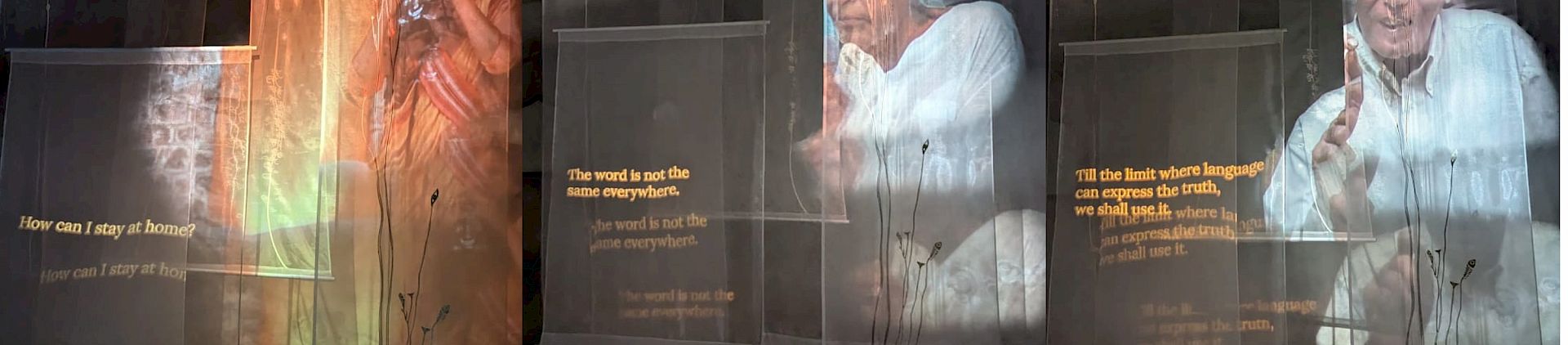
The room is small and dim. Five long, silk veils hang from the ceiling, appearing as if woven from dew. On these translucent screens, drifting into one another like stray thoughts, a Baul singer and a poet speak about the unsayability of love, mocking how language thinks it can do it all.
He wants to go where no one goes, for us to see what we cannot always see about ourselves
This room is real, not just in my mind. I am leaning against G on a long bench in the dark. We are at Ishara House in Kochi, India, watching fragments from the Kabir Project, a 23-year-old archive of mystic poetry written over 600 years in Urdu, Sindhi, Malwi, and Bengali. It is my last day in this city with G; we are always leaving. The Baul woman is singing about Ajab Shahar (meaning ‘Strange City’). Strange cities which promise many wonderful things, only for their inhabitants to realise that what they seek can only be found within.
A city of mirrors jostles my house
my neighbour lives there, I keep feeling
I’ve seen him,
I’ve seen him
G strokes my neck, pressing his fingers into my loose waves when he loves a particular line. Then, while we are holding hands, he scratches his thumb with his other hand, sending a faintest quiver through his palm and mine. I think about how in the ten years I’ve known him and his hands, I have never known this sensation before. I lean in; he is telling me about love codes specific to Kerala, something about loving sardines being quite the dealbreaker (or dealmaker) when two people first size each other up. And how Malayalis, when describing a couple trying to act pleasant in public while engaged in a fight, say in Manglish: there is a ‘spelling mistake’ between them.
In our most immense experience, language lets go of our hand, says a scholar onscreen. We then use signs, symbols, gestures to express ourselves. ‘What we experienced, perhaps this is similar to that. It was like this perhaps … or like that.’
In the dark room, faces and words flutter on the veils, a reminder that we are here only a while. The door’s curtain opens and closes. Visitors slip in and out, deciding whether this room is worth their time, casting light and shadows on the verses.
The title of this piece is excerpted from a verse translated from the Arabic, as featured in Alaq (2025), a cinematic installation by artist Pallavi Paul at the 2025 Kochi-Muziris Biennale.
Endnotes
1 Lines excerpted from the poem, ‘Beds,’ in How Many Countries Does the Indus Cross (2019) by Akhil Katyal, published by The (Great) Indian Poetry Collective.
Cover image: Poems shapeshift and truth lies just beyond the reach of language in the multimedia installation titled Akath Katha: The Untellable Tale (2025). Showcased by The Kabir Project, the installation is part of the Amphibian Aesthetics exhibition at Ishara House in Kochi. Ongoing until 31 March 2026. Image courtesy of the author.
