Three Poems by Tishani Doshi
Read three new poems by Tishani Doshi from her forthcoming collection, Egrets, While War. The first, 'Monsieur Tout-Le-Monde', is dedicated to Gisèle Pelicot, a French woman who became a major feminist figure after waiving her right to anonymity as a victim in a multiple rape case; the poem is meditative, pausing for the 'kerfuffle' of a bird, yet piercing in its portrayal of the commonality of sexual violence. The remaining two poems are sonnets, similarly contemplating the movements of birds and other animals, while studded with reflections on the nature of living itself.
Supported by a grant from the Open Society Foundations.
Monsieur Tout-Le-Monde
for Gisèle Pelicot
It could happen to anyone. Firefighter,
plumber, retired sports coach, Monsieur
Tout-Le-Monde, who exchanges greetings
with you at the baker’s, steps over the threshold,
half undone. Men who married their childhood
sweethearts, who tuck patients nightly into bed,
fled faraway countries, acted under duress. It could
happen — the desire to leave the body, because the body
is the house, and beyond the house, the street,
the village, the hinterland of memory.
I was fourteen, and all I wanted
was to be in my body, to feel the hips and smooth bones,
the power of my own ... I was taken in,
no question. An air-conditioned room. Summer
murk of Madras. Was never asked, Do you want,
or, Shall we embark on this sweetness together?
It was taken. There was no escaping that. It could
happen. Body sidling away from the brain,
earliest ancestors, trancing around a fire,
asking the spirits to put potency into their spines,
so they could pull arrows of sickness out from
one another. I tried hypnosis once but couldn’t let go,
kept thinking, What if I open my legs? What if I
open? All those paintings of Brunhildes and sleeping
goddesses, Venus with Cupid’s fingers pressed
against her lips, Shush, Mother, just shush.
Museums filled with the adoration of naked defenceless
necks. Shepherdesses, nymphs. Legs askew, bare-breasted.
Women tangled in deepest something: sleep, death.
Incubus on belly. Satyr – husband? – crouching
at the foot of the bed.
And we can tell ourselves
it is softness we are after. Heard no sound of protest,
so kept going. Felt no pushing back, so kept going.
Afraid of all my missing parts, so kept going and
going. It is a hot night in March. I’m in the house
alone, and all the tooth-rimmed-terror multiplies.
In the bathroom, a kerfuffle of feathers —
little banded goshawk flown in through
the window, trapped by glass. Not allegory
or metaphor. Bird as real as all the shame
I carry. Monster, we say, for what is both warning
and unordinary. I reach for the goshawk’s face
to remove its mask, but find only goshawk
underneath. It could happen, couldn’t it?
Ambushed by some inner-Leviathan – our own
human creature – while making coffee, or taking
the wife to the doctor. Fork in the road:
Monsieur Tout-Le-Monde in the mirror.
Sonnet for the Two Birds That Kick Off the Ramayana
Because spring starts and mornings start and the forest
newly abud, starts and the sage walking down to the river
starts to find a pair of krauñca birds going at it in a clearing,
and delight starts and transfixing and a hunter on the other
side of the meadow starts to shoot an arrow into this love-making
and death starts in the male bird’s breast and seeing his body
fall to mud his mate starts a terrific lament and the sage
hearing her grief unloosen starts to curse the callous hunter
a life of peacelessness for disrupting this coitus and the grove
in its goings-on listens to this rage coming out apace and the stricken
sage goes on and on and the bird bereft who has folded up
her face hears her broken-heartedness being held by syllables
and being held how the words transform her feeling
into prayer-like-song and this is how a poem starts
Sonnet for the Chātak: Steadfast Bird of Indic
Love Poetry that Subsists Only on Raindrops
Times are different now, Bird. Even the most
ardent love can turn into a leaky radiator.
Ask Borges, abandoned mid-party for another.
Who can imagine their own betrayal? Adios
April, adios May. Adios morose coastal
months of chick in search of a sturdy cage, or
is it cage in search of a sturdy chick? Love’s tormentors
remain the same: moon, breeze, cuckoo strep throat,
disdain of rain cloud as it gallops by. Beak-
parched, heart dry, you make for the nearest tree
and sing. Higher now, with all the feels, until the sea
blackens and groves of pale-gold mangoes heave.
Snakes glide out from sunken homes. Even the bees
cease their wavering, turn skyward with tiny thirsty cheeks.
‘Sonnet for the Two Birds that Kick off the Ramayana’ and ‘Sonnet for the Chātak: Steadfast Bird of Indic Love Poetry that Subsists Only on Raindrops’ appear in Egrets, While War (Bloodaxe Books, 21 May 2026, www.bloodaxebooks.com).
‘Monsieur Tout-Le-Monde' appears in the upcoming Indian and American editions of the collection.
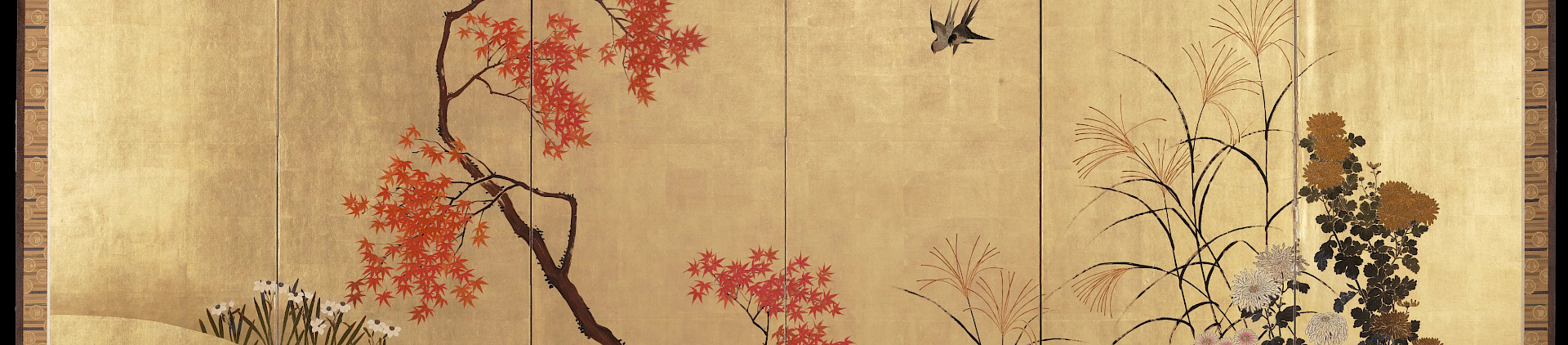
Cover image: Autumn (left of a pair of Birds and Flowers in Spring and Autumn) by Shibata Zeshin

