'The Mouth of a Gash, Sing It Like a Scream': Alton Melvar M Dapanas interviews Khairani Barokka
Khairani Barokka’s debut speculative nonfiction work, Annah, Infinite (Tilted Axis Press, 2025), is a fearless intervention in the literary and artistic terrain, inlaying archival excavation, crip theory, and radical manifesto to resurrect the humanity of Annah la Javanaise, who was obscured by Paul Gauguin’s colonial gaze.
Barokka – a Minang-Javanese poet, editor, translator, and art scholar – challenges the Western, cis, white, male canon of speculative nonfiction, while drawing on Global Majority thinkers like Sara Ahmed and Teresia Teaiwa to reframe narratives of revisionism and erasure. From her incisive critique of the CIA-backed 1965–66 Indonesian genocide, to her contention against colonial and ableist structures in British academia, Barokka’s writings and activism demand we reconsider whose stories are told and how.
In this interview, we explore how Annah, Infinite reshapes speculative nonfiction, its disruption of genre norms, and its strategies for disputing the racial, gendered, and ableist biases of fraught literary and artistic spaces, proposing a decolonial vision for the future.
by Alton Melvar M Dapanas
Alton Melvar M Dapanas: First of all, Dr Okka, huge congratulations on your speculative nonfiction debut, Annah, Infinite! In our past conversations and your earlier work (primarily your poetry collections and critical essays in Violent Phenomena and River In An Ocean), you’ve often emphasised writing at the pace your bodymind demands. Given that Annah, Infinite first appeared as an essay in The White Review, and then within your PhD dissertation at Goldsmiths, I’d love to hear how its expansive form finally came together. Could you walk us through its evolution?
Khairani Barokka: Thank you kindly for the congratulations, and for taking care with these questions. It’s a pleasure to speak with you again. I’m so pleased you began with the practice of writing at the pace of our bodyminds, because Annah, Infinite is nothing if not a testament to writing on crip time, slow time. I started conceptualising this book when I first saw Paul Gauguin’s painting Annah la Javanaise (1893) in 2011. This was when I first began to identify as physically disabled, and simultaneously started experiencing intense violence as a result of disbelief. Annah, Infinite is the culmination of me trying to understand why I experienced the horrors that I did from a historical perspective, and to literally escape them, while imagining similar possibilities of escape in stories of Annah. If I’m not mistaken, the earliest piece that made it into the final book is the poem ‘Sliding Scale’ (written around 2011-2012), which was also featured in a 2014 one-woman show, Eve and Mary are Having Coffee.
Paul Gauguin. Annah the Javanese, or The Child-woman Judith Is Not Yet Breached. 1893.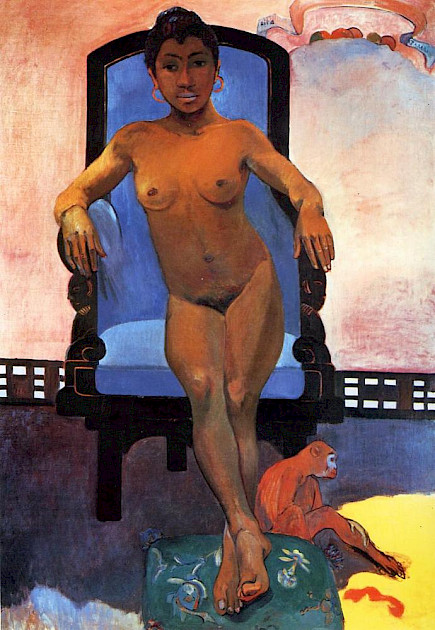
This book project was just something I persisted in willing into existence, to accompany me through abject medical and societal neglect and ableist abuses, and I just knew it would take the time it would take. I remained open to the impetus behind this book manifesting itself in different forms, from performance poetry to digital collage to performance installation to theory to fiction … The Annah, Infinite project was a whole 14-year-long process that included various artistic manifestations, but I knew that all of them would coalesce into book form, and all of them would show me yet another facet of the subject. I had to go through a whole personal journey and learn key lessons that are in the book — that took much longer than I thought it would, but it also took exactly the right amount of time, and I wouldn’t have done it any other way. If it had taken less time, the final manuscript wouldn’t have included things I’ve had to learn only very recently. You always think you’ve learned enough, and then life teaches you another lesson.
AMMD: I’m captivated by Annah, Infinite as a work of speculative nonfiction. The book morphs from archival excavation to illness narrative, from diaristic intimacy to radical manifesto, even enmeshed with redacted prose and crip theory. What made you write under this genre, rather than call it, for instance, autotheory or experimental memoir?
KB: I love this question, and I am not not calling it autotheory or experimental memoir. Just like the titular figure, I am open to many multiform ways of describing this work, and I welcome others calling it something that resonates with them, if it honours the source material. I’m more interested in being open to possibilities for interpretation of the text than fixing it to only one demarcation. I absolutely do see ‘speculative nonfiction’ as a term that intentionally destabilises, and I’m not alone in this; it’s been great to see more and more writers take on the speculative in (re)writing histories. Having immediately noticed massive discrepancies in supposedly solid art historical ‘facts’ about Annah – whether with regards to their ethnicity or how Gauguin came to know them – I wanted to emphasise that much of what is inscribed as Western ‘art history’ is already very much speculative, very much in the realm of fiction. And that opens up the subject to so many more potential realities, crucially realities in which Annah/s are protected.
The redactions were made to hopefully protect readers from particularly triggering words or phrases. As to hopes for how readers physically engage with less defined parts of the text such as these, I am not prescriptive — the hope is actually for each reader to find resonance with their own individual lives and bodyminds within these words, and that is an individual response.
AMMD: Let’s address the obvious: Annah, Infinite is about Paul Gauguin’s 1893 painting Annah la Javanaise and Annah, the actual person who modelled for it. Yet the archival record presents us with what I can call a colonial hall of mirrors. The National Gallery of Art’s 1988 exhibition notes identify her as a thirteen-year-old from Ceylon, ‘procured’ through Gauguin’s dealer, Ambroise Vollard. Jill Fell’s biography of Alfred Jarry (2010) terms Annah as a ‘conspicuous Tamil mistress.’ Kathy Borrus' Five Hundred Buildings of Paris (2010) insists she was Indonesian, while other sources say ‘Malaysian’, ‘mulatto’, and ‘Polynesian’. French accounts oscillate between domestic caricature and sexualised myth. Even Nobel laureate Mario Vargas Llosa’s prose drips with Orientalist exoticism towards Annah, while an essay in The Annual of Psychoanalysis Volume 22 (1994) reduces her to a ‘Third World Lolita’, a framing that parallels her with the fate of Manet’s Olympia, as Bertrand Westphal notes. Given this grotesque kaleidoscope of imperial fantasy masquerading as biography, how did you approach the dual task of forensic excavation and literary exorcism requisite to resurrect Annah from such polluted archives?
KB: ‘Grotesque kaleidoscope of imperial fantasy’ is such an apt way of describing all of these portrayals of Annah/s. The forensic excavation necessarily gave way to literary exorcism. Why is it that a portrait subject labelled ‘la Javanaise’ immediately opens itself up to so many different interpretations? Why does it not matter what colony Annah/s are from, as long as it is a colony? I must say I found this particularly troubling and fascinating as a Javanese person myself. I learned a lot about the mythos of Java to the French that arose in the late 1800s, largely due to the 1889 World’s Fair’s Javanese pavilion in Paris. And there was a continual pull to interpret all of these kaleidoscopic distortions of where I come from – and the people I come from – through my own disabled bodymind, a bodymind that was struggling to understand why it was continually being subjected to colonial violence, despite ‘advantages’ to survival in the West, such as being fluent in English. I knew there was a throughline there, between how the memory of the person or people in the painting were treated, and how I and untold millions of others have been treated. I needed to process the ableist imperial frame and hold a mirror to itself, as well as to create a framework of infinite possibilities in lieu of many contradictory ‘facts’ being upheld as absolute truth.
I wanted to emphasise that much of what is inscribed as Western ‘art history’ is already very much speculative, very much in the realm of fiction.
AMMD: Vargas Llosa’s exoticism reveals how Annah’s story has been weaponised. How do you balance creative freedom with the ethical gravity of reimagining a figure so often distorted — given that speculative nonfiction allows us to transgress the limits of histories?
KB: The creative freedom is inextricably intertwined with the ethical gravity of reimagining anyone from history perceived as not having defined themselves. Showing supposed truths to be fictions and supposed fictions to be possible truths – infinite possible truths – allows for escape routes, and indigenous and disabled frameworks of time and space to come to the fore and pick apart harmful determinisms. Annah/s could have been plural, could have been of any gender, could have been a wide variety of ages. Crucially, all of them were in grave danger, and all of them could have escaped. There are recorded escape stories of Annah/s that are absolutely fascinating — including one I came across that involves a discovery by a physics professor, [suggesting] Annah/s could have been responsible for who was attributed as the creator of an entire Western art movement. And there are infinite potential other escape stories in Annah, Infinite that I detail, allude to, or hopefully create space for.
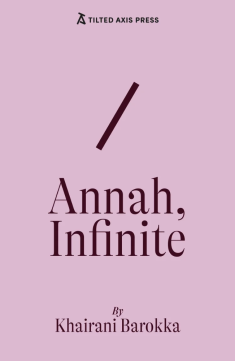
AMMD: In ‘The Pained Archive', one of the essays from Annah, Infinite, you observe:
‘The public is not taught that Gauguin was a menacing and abusive man by the arts institutions where Annah la Javanaise might be hung, nor is the public taught that Annah is a human child, nor is the public taught the power differential between a child coded “Javanese” and an older man coded “French”, one that persists to this day.’
As an artist and art scholar, how do you see this deliberate silence within the art world and the complicity manifesting in curatorial practices today? And what steps might museums and other art institutions take to confront these legacies in a way that respects the humanity of figures like Annah?
KB: I think the imagined audiences for art curators, and the possibilities of empathy from them towards marginalised figures from history, could do with a lot of expansion. I think everyone should consider their positionality with regards to portrayed figures in historical artworks, and I think colonial ableism and, within that, fictions being regarded as ‘facts’, continues to plague art institutions. Part of the solution is giving more agency to communities of the people being portrayed in historical artworks to be in positions of power in the arts. But part of how the art market functions as part of colonial capitalism is precisely the deliberate withholding of access to portrayals of people from the communities they come from. In fourteen years of research, not once was I able to see Annah la Javanaise in person. Though I have a pretty good idea of which wealthy family owns the painting, it was almost amusing to go down rabbit holes created by people working for the uber-rich to ensure the specifics of who owns what are deliberately obscured to the public. There are still massive amounts of Indonesian artefacts and portrayals of Indonesian peoples in places where the vast majority of us will never be able to go, whether for financial and/or visa reasons, or simply because they are not made available to the public at all. As long as high finance and questionable funders and frameworks are entangled with arts institutions – and I’m also mindful of the fact that institutions’ jobs are to reproduce themselves, above anything else – meaningful change will be difficult. Repatriation of artefacts and real reckonings with regards to colonial artworks have a long way to go; I hope Annah, Infinite will go some small measure towards remedying that.
AMMD: Your essay ‘Nightmares of 1965’ lays bare the 1965-66 Indonesian genocide, where the CIA-backed 30 September Movement (G30S) paved the way for General Suharto’s rise, President Sukarno’s fall, and the mass killing of 500,000 to two million people: labour unionists, teachers, Chinese Indonesians, indigenous peoples, and LGBTQIA+ individuals. Inspired by Annah, Infinite’s call to rehumanise erased voices, how might scholars and activists collaborate with affected communities (especially gender and ethnic minorities) to espouse truth-telling on the 1965-66 atrocities in Indonesia, alongside ongoing genocides in Palestine, Darfur (Sudan), Tigray and Amhara (Ethiopia), the Democratic Republic of Congo, and the Rohingya Muslims in Myanmar, and Uyghur Muslims in China?
KB: One thing I really needed to emphasise in this book is that resistance to these genocides by scholars, activists, artists, and everyday people has always been there. I cite Intan Paramaditha’s scholarly work, which is so spot-on in identifying how Western narratives in documentaries like The Act of Killing erase Indonesian resistance to colonial genocide, in favour of a narrative of masculinist colonial ‘discovery’ with regards to the 1965-66 genocide as uncovering ‘a dark truth’. This is really jarring to experience as an Indonesian watching these kinds of media. Much evidence of resistance isn’t translated (often for good reason), and has to exist in subterfuge and code; it isn’t for an outside gaze. But there has necessarily been enormous resistance, often at great and violent cost, and that resistance continues. I’m heartened by various movements by young people to create accurate historicising of 1965-66 over the years, though what is taught in history lessons in schools continues to have a patina of the New Order regime — I mean, our current president was literally a war general under Suharto. The past is the present. But wherever there is colonial genocide, there is resistance, and those most affected should be the ones telling those stories, or choosing when not to, deciding who the audience is.
But part of how the art market functions as part of colonial capitalism is precisely the deliberate withholding of access to portrayals of people from the communities they come from.
AMMD: In another essay, ‘annah #843 with bodily memory’, you meditate on the opera singer Nina Pack, and the resistance you came up against in British academia when critiquing her legacy:
‘The more cocooned you are in the structures of white supremacy, the less you understand the pain you cause others regularly by virtue of the racism that we swim in every day in the UK and Europe. It is not “unconscious bias”, a term which truly lets people off the hook for their violence, which exists to make people feel better about the ways they deeply hurt others.’
You highlight how academic and artistic spaces often champion colonial and ableist structures, particularly when PhD dissertations (such as yours) are expected to cite Western, white scholars only. How do you see Annah, Infinite confronting these entrenched norms in British academia and the larger art world? And what strategies might scholars employ to dismantle the privileging of white, ableist perspectives in disciplines like literature and translation?
KB: A really shocking statistic I mention in the book, which I came across while writing, is that in 2020, only 2.1% of UK university professors were Black and/or Asian women. It took witnessing and experiencing a lot of continued alienation and racist ableism within UK academia and the arts for me to really understand why that is. It’s such a precarious sector in general. There is a skewed tendency across academia to defund or underfund – or eliminate entirely – arts and humanities endeavours, and this outcome of capitalism is a sorry one. Honestly, universities are where a lot of colonial capital is accumulated, and I would love for Global Majority scholars and artists, particularly in universities and learning collectives outside centres of power, to have access to the same resources. This includes learning collectives of D/deaf and/or disabled artists and writers.
In some sense, I definitely wrote Annah, Infinite to connect with others who have had similar experiences in empire’s academic centres, or to wake up people who are unaware of them, to understand just how violent and extreme the consequences of multiple marginalisation are for people in bodyminds like ours. I wanted to convey all of these violences in a way that inspires opportunity for change, for escapes. And I think each of us can try to change matters in infinitesimal ways unique to our situations, whatever we feel called to do, and that we feel we are able to, within societal constraints.
As long as high finance and questionable funders and frameworks are entangled with arts institutions – and I’m also mindful of the fact that institutions’ jobs are to reproduce themselves, above anything else – meaningful change will be difficult.
AMMD: Annah, Infinite engages with speculative nonfiction, a genre domineered by a Western, white, cishet male canon: Von Braun’s The Mars Project, Alan Weisman, Rudy Rucker, Edward Castronova’s Exodus to the Virtual World, Percival Lowell, Joshua Cutchin, HG Wells, even Speculative Nonfiction magazine. With the Indonesian-born Hong Kong essayist Xu Xi standing as one of the rare voices from the Global Majority in this space, how do you envision Annah, Infinite reshaping this landscape to challenge its colonial, gendered, and racial biases?
KB: Honestly, I am just grateful to each and every reader of the book, and won’t presume to determine precisely how it’s going to change the literary landscape — but I do want Annah, Infinite to nurture our communities of speculative writers from the Global Majority, and I know there are so very many of us. I want it to show people that you don’t have to write by the rules; you can write the book you want to write and fight for that. It was a very long journey to get this book to publication, and that included receiving doubt from people in the industry – clearly unfounded – about it being publishable at all. Keep going — if you believe in your story enough, you won’t give up on it. Speculative writing is incredibly exciting, and will keep surprising us, each writer doing so in their own way. I knew this was an art project that would involve interdisciplinary artistic modes. I knew the poetry, fiction, and nonfiction that was pouring out of me intermittently about Annah all had its place. And I insisted on that. Working with a structural editor was a wonderful way to further hone all the materials I’d amassed over the years towards the book. As you can imagine, [with the project] being part-memoir, I really appreciated the outside perspective.
I employ the speculative when writing about the past by making the reader question why we pin down ‘maybes’ as facts when writing about the past. All other accounts on Annah determine that they’re a cis girl, for instance, when honestly, they could have been trans and/or nonbinary and/or of a non-Western gender. I really tried to think of how to reduce violences when talking about a person or people who really existed, and therefore wanted to emphasise that a lot of what we think of as ‘fact’ is fiction, and vice versa. I wanted to write speculative biography through indigenous cosmology. We don’t have time tenses in the Indonesian language, after all.
AMMD: To close, you draw on the scholarship of thinkers like Sara Ahmed, Safiya Umoja Noble, and Teresia Teaiwa, while also braiding the legacy of late twenty-first century feminist movements in Indonesia. Could you share which Global Majority writers, thinkers, artists, and scholars have been most influential in shaping your creative and intellectual ethos from your early days through to Annah, Infinite?
KB: It is such a struggle to come up with a list, because over the past fourteen years, I’ve absorbed so much from so many, including many people I cite in Annah, Infinite. I genuinely do feel that living in Indonesia and being aware of our feminist histories in general has a lot to do with it. Being exposed to so many indigenous knowledge systems and activist movements has a lot to do with it, and just living life in a disabled, migrant body that nobody was properly helping for a long time – despite being ‘in plain sight’ in the arts – has a lot to do with it. It’s embodied knowledge and knowledge that has therefore been passed down to me through all the women who came before me. It’s reading widely, trying to be part of different communities, and it’s also just coming to a place like the UK and realising how much is out of place — not universal at all yet constantly touted as being so. And recording my observations where I could and how I could, through complex PTSD.
I wanted to write speculative biography through indigenous cosmology. We don’t have time tenses in the Indonesian language, after all.
I dearly wish I had been able to speak with Teresia Teaiwa before she passed away, as her perspective on Gauguin as an i-Kiribati and African American woman was priceless. And she was also a poet, and was actively against the genocide in Papua. She is definitely someone I’d like to think Annah, Infinite is in kinship with and pays tribute to. I feel, as a whole, that there are endless influences in minute and gargantuan ways, from so many people, that make up this book. Every book is a composite of how the people we appreciate and hold dear have shaped our lives as writers, and I am grateful for each lesson learned, and for each teacher.
Header image: Indonesian Landscape by Abdullah Suriosubroto


Inside Wasafiri 123, you'll find interviews with Andre Bagoo and Christina Sharpe, a lead feature poem by Devika Rege, our 2024 Essay Prize winning articles, and much more. The issue also includes a special section – Tibet: In Focus – showcasing creative-critical commentary by a range of contemporary writers, translators, and artists.